


Read the tide, the season and the wind before you go
Britain's coastline is one of the richest wildlife habitats in Europe, but it operates on its own timetable. Turn up at the wrong hour and you'll see nothing but empty rock. Get it right and you'll be surrounded by puffins, hauled-out seals or a thousand waders swirling over an estuary.
Start with the tide table. Low water exposes rockpools, mudflats and feeding grounds for waders; high water pushes birds into roosts and seals onto offshore skerries. Aim to arrive roughly two hours before high tide, then settle somewhere comfortable and let the water bring the wildlife to you. Low spring tides are a different day out entirely, best for rockpools and uncovering the smaller creatures of the shore.
Weather matters too. A brisk onshore wind after a spell of rough weather blows seabirds and sometimes unexpected ocean wanderers close to land, so a blustery headland in September can be far more productive than a calm one in June. Dawn is almost always better than midday, and the hour before dusk is a close second.
Seabird cities: cliffs, stacks and offshore islands
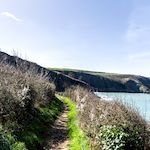
The biggest colonies sit on remote islands and headlands — East Yorkshire's chalk cliffs, the Farne Islands, Skomer, Rathlin, the Isle of May, and the great seabird strongholds of Orkney and Shetland. You don't need a boat to enjoy them. A clifftop path, a pair of binoculars and patience will do.
- Stay on the marked path. Grass on clifftops is often riddled with puffin and shearwater burrows, and a careless footfall can collapse a nest chamber.
- Sit down to watch rather than standing silhouetted on the skyline — birds settle faster when you're low and still.
- Never walk out onto grassy slopes to photograph a puffin. Use a long lens or a scope instead.
- Keep visits short at busy colonies, and move on if birds start alarm-calling or circling overhead.
Estuaries and beaches: the winter wader spectacle
From October to March, Britain's estuaries host hundreds of thousands of overwintering waders. Knot, dunlin, bar-tailed godwit, oystercatcher and curlew gather on mudflats at low water, then crowd onto high-tide roosts on saltmarsh, shingle and even car parks. The Wash, Morecambe Bay, the Dee and the Severn are among the great gathering points.
The single most important rule here is simple: never walk through a roost. A flock that flushes repeatedly burns energy it needs to survive cold nights, and repeated disturbance can push birds off a site entirely. Watch from the path, use a hedge or a wall as a hide, and if a flock takes off as you approach, you're already too close.
Ringed plovers and oystercatchers nest directly on beaches between March and July. Their eggs and chicks are near-invisible against shingle, so keep to the lower shore or the path, and give any bird that starts running, calling or pretending to have a broken wing a very wide berth — that's a distraction display, and it means you're near a nest.
Seals, dolphins and basking sharks
Grey seals pupped along British coasts through the autumn and early winter; common seals tend to pup in summer. Both haul out on sandbanks, rocky shores and remote beaches to rest, digest and warm up, and both are protected by law from deliberate or reckless disturbance.
Watch from at least 100 metres, ideally with binoculars or a scope. Keep quiet, keep low, and never position yourself between a seal and the sea — that's the escape route, and blocking it causes real stress. If heads come up and the group starts shuffling towards the water, you've pushed too far. Abandoned seal pups are almost never orphaned; their mothers are usually nearby, waiting for you to leave. Never handle one.
Further offshore, the Moray Firth and Cardigan Bay are the classic spots for bottlenose dolphins, while basking sharks cruise the surface off Cornwall, the Hebrides and the Isle of Man from May to October. From a boat, keep your distance, never chase or cut across an animal's path, and give mothers with calves a much wider berth.
Otters, rockpools and the smaller coast dwellers
Shetland, the Hebrides and the west coast of Scotland hold the densest otter populations in Britain. Look for spraint on flat rocks and seaweed-covered skerries, then scan the water at first light. An otter fishing is usually visible as a rolling, diving shape and a trail of bubbles. Stay downwind, stay still, and give it at least 50 metres.
At low water, rockpools reward a slower kind of looking: beadlet anemones, chitons, blennies, brittle stars and hermit crabs. Use a small torch and a plastic viewing box, and always turn stones back exactly as you found them.
Fieldcraft, kit and the law
- A decent pair of 8x42 binoculars is the single best investment you can make; a spotting scope helps for distant rafts and roosts.
- Wear muted colours, move slowly, and learn to use your peripheral vision rather than staring directly.
- Keep dogs on a short lead between March and July, and under close control near roosts and haul-outs at any time of year.
- Drones are a poor idea and often illegal near nesting seabirds and seals — the disturbance they cause is real and prosecutable.
- All wild birds, their nests and eggs are protected under the Wildlife and Countryside Act, with the most sensitive species receiving the strictest protection. Disturbing them is an offence, not just bad manners.
- Think twice before posting precise nest or haul-out locations online. Share the experience, not the coordinates.
Observe well and the coast gives generously. Stay back, stay quiet, and the wildlife will carry on around you as though you weren't there — which is exactly the point.




John Doe
14 January, 2022Having no content in post should have adverse..
Chauffina Carr
10 April, 2022We use these tests all time! Killer stuff!
Jim Séchen
16 July, 2022Thanks for all the comments, everyone!